
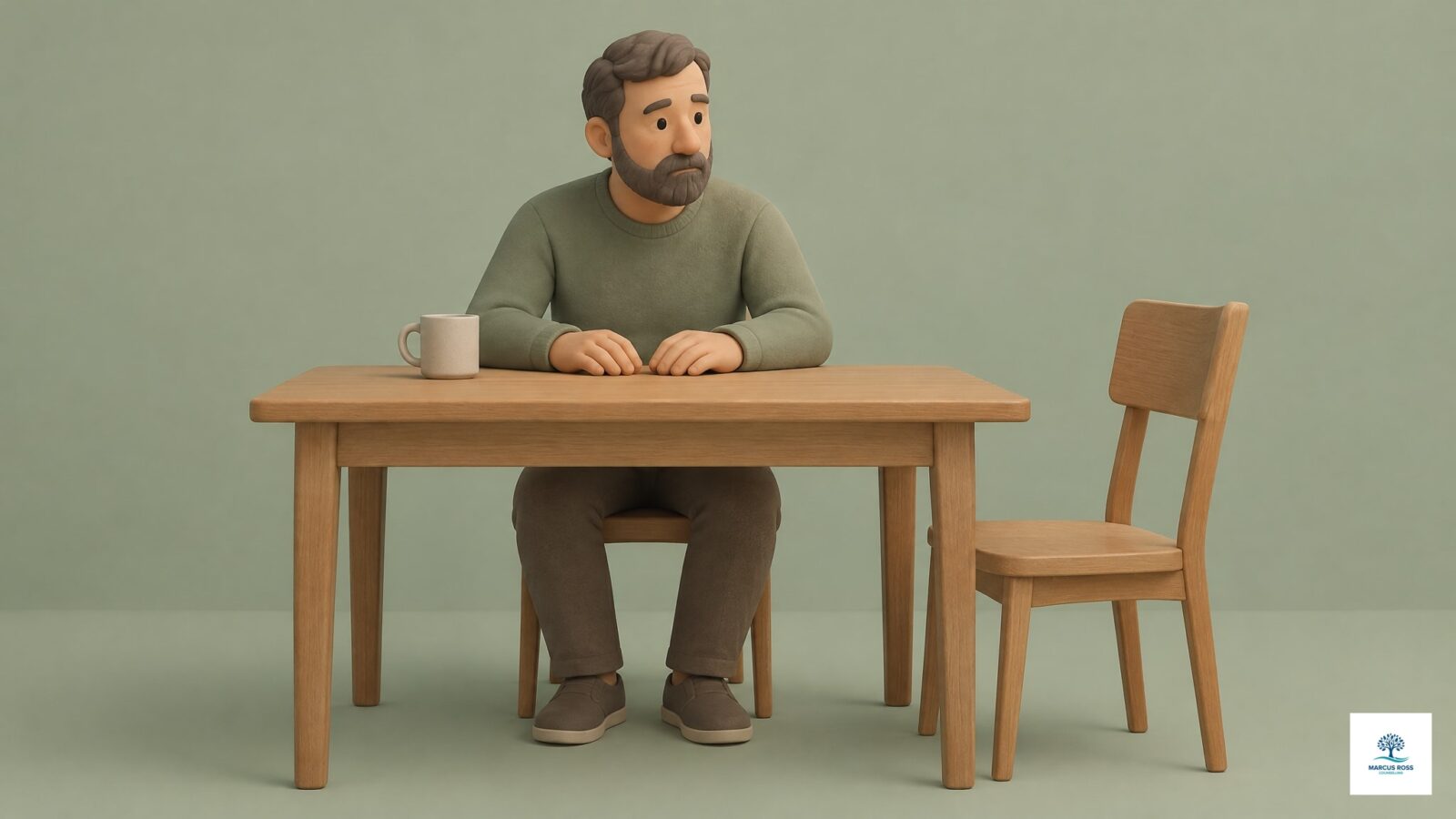
Men’s Mental Health: My Honest Journey as an Everyday Bloke
You might be reading this because the ground has shifted under your feet and you’re not sure where to stand anymore. For a lot of men in their thirties, forties and fifties, a big upheaval, separation, a major career change, doesn’t just change your circumstances. It challenges who you think you are.
This isn’t just feeling sad or stressed. It’s a disorientation that leaves you questioning your purpose, your value, your direction, long after the initial crisis has passed.
I know this terrain because I’ve walked it myself. I walk alongside other men navigating the same ground now, through my counselling practice. My approach to men’s mental health is grounded in that lived experience rather than clinical distance. We focus on practical rebuilding and honest conversation, not diagnostic labels. If you’re wondering whether what you’re feeling warrants support, or you just want to understand why everything feels so heavy right now, reading this is already the first step.
When Men’s Mental Health Shifts After Separation or Career Change
The most common thread I see in men after a major life transition isn’t a textbook mental illness. It’s a deep, often unrecognised grief over lost identity. You spent decades building a sense of self around being a provider, a partner, a father present every day, or a professional with a clear title and trajectory. Then that structure dissolved, almost overnight. The silence in the house at what used to be family dinner time. The empty calendar where work once filled every hour. The sudden absence of the role that told you who you were. That can create a void no amount of busyness fills.
This identity gap is often at the heart of men’s mental health struggles during separation or career transitions, yet it rarely shows up as obvious sadness or tearfulness that others might recognise. Instead, men’s mental health challenges often surface as irritability, withdrawal, or overworking after major life transitions like divorce, rather than as overt sadness or tearfulness. You might find yourself snapping at mates, avoiding social invitations, or throwing yourself into work with an intensity that looks like productivity but feels more like escape. You may not even connect these behaviours to the loss you’ve experienced, because they don’t feel like grief. They feel like frustration, restlessness, a vague sense of uselessness you can’t quite name.
Recognising this as identity loss rather than personal failure is genuinely the first step toward stabilising your mental health. It reframes what you’re going through as a human response to profound change, not a character flaw. I’ve been through relationship breakdown and loss myself, and rebuilt from it, and I can tell you plainly: the disorientation you feel isn’t a sign you’re broken. It’s evidence that something central to your sense of self has been disrupted and needs deliberate attention. When you understand that your irritability or withdrawal is grief wearing a different mask, you stop fighting yourself and start creating space to rebuild something meaningful from what remains.
This kind of identity loss after separation or career change needs a different kind of support than standard stress management. The work isn’t about fixing a dysfunction. It’s about reconstructing a coherent sense of self when the old foundations have crumbled. You’re not trying to get back to who you were before, that person doesn’t exist in the same context anymore. You’re learning who you can become now, with honesty about what’s been lost and curiosity about what might still be possible. That takes time, and it often helps to have someone alongside you who understands the terrain from having navigated it themselves, not just from a textbook.
Counselling for men in this situation focuses less on processing emotions in the abstract and more on practical meaning-making: what still matters to you, what values persist beyond roles, small concrete steps toward a life that feels like yours again. This isn’t about positive thinking or forced optimism. It’s about tolerating the discomfort of uncertainty while gradually building new anchors for your identity, ones that don’t depend on external validation or a script someone else wrote. The goal isn’t to erase the pain of loss. It’s to fit it into a broader story that still has room for possibility, connection, and purpose.
Recognising the Signs Something Needs Attention
You don’t need to be in acute crisis, or tick off specific diagnostic criteria, before reaching out. Waiting until you’re completely overwhelmed usually makes the rebuilding process longer and harder than it needs to be. The practical signs that your mental health needs attention are usually visible in your daily life and relationships long before they become unmanageable, and noticing them early gives you more say in how you respond.
Watch for persistent irritability that surprises even you. Emotional numbness where you used to feel engaged. Avoidance through constant busyness or substance use. Sleep that won’t settle no matter how much rest you get. A growing disconnection from family or mates. These are all worth taking seriously rather than pushing through.
These signs matter not because they point to pathology, but because they suggest your current coping strategies aren’t enough for the weight you’re carrying, and white-knuckling through it is costing you more than you realise. You might notice conversations with friends start to feel performative rather than genuine. Things you once enjoyed now take effort you can’t summon. Your patience for everyday frustration has worn dangerously thin for no clear reason. None of that is a moral failing. Your nervous system is telling you something needs to shift, and ignoring it doesn’t make it go away. It usually gets louder.
If you’re unsure whether what you’re experiencing crosses the line into needing professional support, reading about the signs it’s time for counselling can help you tell the difference between normal adjustment and a pattern that needs dedicated attention. Good support for men goes beyond standard mental health care, into the practical stuff, relationships, family connections, wellbeing, because men’s mental health is never separate from the relationships and structures you actually live inside. You don’t need the perfect words for your distress, or a clean diagnosis, to justify reaching out. If something feels persistently wrong and your usual strategies aren’t working, that’s reason enough.
Trust your own read on sustained changes in how you’re functioning and connecting, rather than waiting for someone else’s permission to take it seriously. Plenty of men minimise their own struggles because they compare themselves to people who seem to be coping better, or because they think admitting difficulty means admitting defeat. That comparison misses the point: everyone’s threshold and timeline is different. What matters isn’t whether your situation is worse than someone else’s. It’s whether your current life is sustainable and lines up with the life you actually want.
Paying attention to these signals is self-respect, not self-indulgence. You deserve support before you hit breaking point, not only after you collapse. Getting into counselling early doesn’t mean you’ve failed to handle things on your own. It means you’re being strategic about preserving the capacity to show up for the people and commitments that matter to you. Waiting until burnout, relationship breakdown, or health problems force the issue usually costs far more in time, energy, and relational damage than addressing things while you’ve still got some reserve left.
What Reaching Out Actually Looks Like
Asking for help can feel like admitting failure, especially if you’ve built your identity around self-reliance and solving problems on your own. That reluctance is completely understandable, not something to be ashamed of.
The first step doesn’t have to be committing to ongoing therapy, or laying out your deepest pain to a stranger. It can be as simple as booking a free 20-minute Connect Call to ask questions, get a feel for whether we’d work well together, and decide if it’s the right fit. No obligation, no pressure. That call exists specifically to take the uncertainty out of the equation, so you can gauge comfort before deciding anything.
Counselling with me is conversational and trauma-informed. We move at your pace, focus on what’s relevant to you right now, and prioritise safety and practical rebuilding over endlessly rehashing painful experiences. If you’re curious about the process itself, what happens in counselling can ease some of the anxiety about the unknown, so you walk into that first conversation with clearer expectations. Sessions run online Australia-wide for flexibility and privacy, or in person in Central Ballarat if face-to-face feels more grounding for you. Both options come with the same commitment to respectful, non-judgemental support shaped around your situation.
This work isn’t about being told what to do, or handed generic advice. It’s about having a dedicated space to think out loud with someone who listens carefully, asks useful questions, and brings both training and lived understanding to the conversation. You keep full say over what you share, what goals you chase, and how fast you move, because change that lasts comes from you, not from something imposed on you. My job isn’t to fix you. It’s to help you reconnect with your own capacity for clarity, resilience, and direction when those things feel out of reach.
Looking into counselling services for men doesn’t lock you into anything. It just opens a door you can walk through, or close, based on what feels right for you right now. If you’re ready to test whether this kind of support might help, booking a free Connect Call is a low-stakes way to start, no commitment, no expectation. You deserve to know what’s available before deciding whether to engage, and that first conversation costs nothing but twenty minutes of your time.
Frequently asked questions
How do I maintain good mental health during a major life transition?
Maintaining mental health during upheaval means prioritising basic rhythms like sleep, movement, and connection even when motivation is low, rather than waiting to feel better before resuming them. It also involves naming what you are experiencing honestly instead of minimising it, and allowing yourself to grieve losses without judging that grief as weakness. Professional support can provide structure and accountability during this period when self-directed efforts often falter.
What are the symptoms of mood disorder in men?
In men, mood disorders frequently present as irritability, anger, risk-taking, substance use, or emotional withdrawal rather than overt sadness or crying. Sleep disturbance, persistent fatigue, loss of interest in previously enjoyed activities, and difficulty concentrating are also common indicators that warrant professional assessment. These symptoms reflect underlying distress even when they do not match stereotypical presentations of depression or anxiety.
Are there free online support groups for depression and anxiety?
Yes, organisations like Beyond Blue, MensLine Australia, and Lifeline offer free peer support groups and online forums specifically for men experiencing depression, anxiety, or relationship breakdown. These provide connection and shared understanding without cost, though they complement rather than replace individual counselling for complex or persistent issues. Check each organisation’s website for current schedules and eligibility, as offerings change regularly.
What are practical self-care ideas for men going through separation?
Effective self-care during separation includes maintaining physical routines like regular exercise and consistent sleep times, scheduling intentional social contact even when isolation feels easier, and engaging in activities that reinforce identity beyond the lost relationship. Limiting alcohol and avoiding major decisions while acutely distressed also protects your capacity to rebuild thoughtfully. These actions are not indulgent; they preserve the foundation you need to navigate uncertainty without compounding harm.