
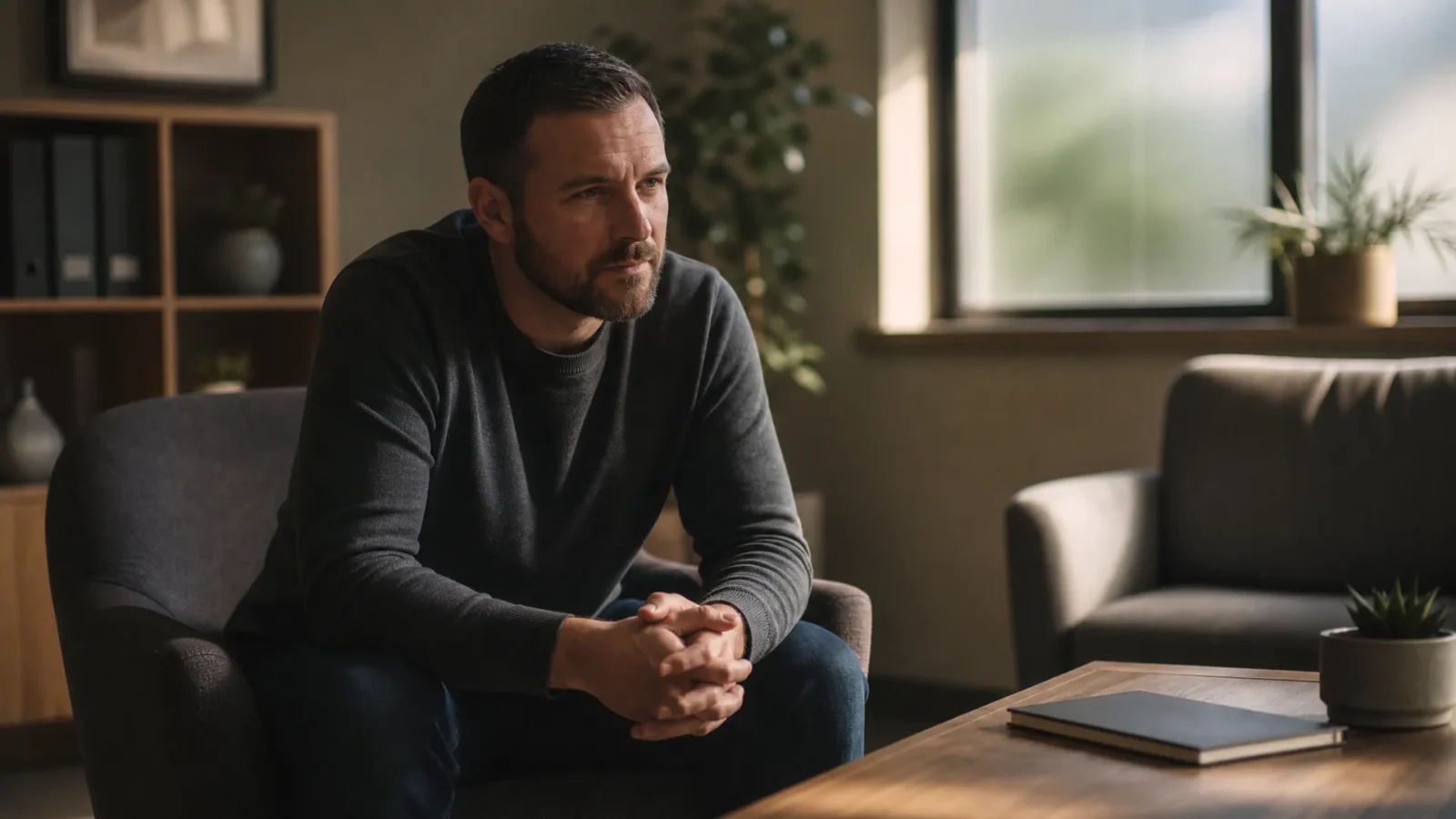
Confidential Counselling Protects Your Privacy by Law and Ethics
If you’re reading this, there’s a decent chance you’ve already Googled “is counselling confidential” at least once, probably late at night, probably on your phone, probably hoping no one noticed. That’s okay. It’s a completely reasonable thing to wonder. And the fact that you’re asking is a good sign, not a problem.
Confidential counselling is supposed to mean your business stays your business. But when you’ve never been to a counsellor before, that reassurance can feel hollow. So let’s actually unpack what it means, practically, honestly, and without the legal fine print that nobody reads.
The Question Most Blokes Are Afraid to Ask
The real question isn’t usually “is counselling confidential?” It’s “will anyone find out?”
Will your boss know? Your mates? Your ex? Will it show up somewhere, follow you around, or be used against you in some way you can’t predict?
These aren’t irrational fears. A lot of men have grown up being told, directly or just by example, that you sort your own problems out. That asking for help is weakness. That keeping your struggles private is the same thing as being strong. So when something finally gets big enough that you’re considering talking to someone, the last thing you want is for that decision to become public knowledge.
That instinct makes complete sense. It’s one of the main reasons men across Australia put off getting support for far longer than they need to. The Australian Institute of Health and Welfare consistently finds that men are significantly less likely than women to seek professional help for mental health concerns, and privacy fears are a real part of that pattern.
You deserve a straight answer. Here it is.
What Confidential Counselling Actually Means in Practice
When you see a counsellor in Australia, everything you share is kept private by professional and ethical obligation. It doesn’t go anywhere, not to your family, not to your friends, not to anyone unless you specifically ask your counsellor to share it.
Counsellors who are members of peak professional bodies like the Australian Counselling Association (ACA) or PACFA are bound by formal codes of ethics that treat confidentiality as a foundational requirement. Not a courtesy, a requirement. It’s the professional equivalent of a vault.
What you say in a session stays in the session. Full stop.
Does My Employer Find Out About Counselling?
No. Your employer has no access to your counselling records, no way of knowing you’ve booked a session, and no right to that information.
The only way your employer would ever know you’re seeing a counsellor is if you told them. Some people choose to tell their manager or HR if they’re accessing an Employee Assistance Program (EAP) through work, but even then, your counsellor doesn’t report back on what was discussed. The session content stays private regardless of who’s paying for it.
If you’re booking private counselling, like working with me, your employer isn’t in the picture at all. Not even a little.
What About Medicare, Health Funds, or My GP?
This is worth being clear about, because it trips people up.
If you access counselling through a GP Mental Health Care Plan, your GP will know you’ve been referred and will receive a brief update on your progress. That’s a normal part of coordinated medical care, and most people are comfortable with it. But that information stays within your treating health team, it doesn’t go to insurers, employers, or anyone outside your immediate care.
If you pay privately, without Medicare or a health fund claim, there’s no referral paper trail at all. Nothing goes to your GP unless you want it to.
Private health fund claims are processed like any other health claim, the insurer sees a billing code, not session notes. Your counselling records are not shared with insurers or used to affect your coverage.
The Limits of Confidentiality, Explained Without the Legalese
Confidential counselling is not unconditional in every situation. Any counsellor who told you otherwise wouldn’t be being straight with you. But the exceptions are specific, rare, and not a surprise.
When a Counsellor May Need to Break Confidentiality
There are three situations where a counsellor is legally or ethically required to act, even if you’d prefer they didn’t:
- Serious risk of harm to yourself or others. If there’s a genuine, immediate risk that you or someone else could be seriously hurt, your counsellor has a duty to act. This doesn’t mean talking about dark thoughts automatically triggers a crisis call, it means if the risk is real and imminent, your safety comes first.
- Mandatory reporting of child abuse. Across all Australian states, counsellors are required by law to report if they have reason to believe a child is being abused or is at serious risk. This is a legal obligation, not a discretionary one.
- Court-ordered disclosure. In rare legal circumstances, a court can require that records be produced. This is uncommon in everyday counselling practice.
These situations come up far less often than most people fear. A good counsellor will explain all of this in your very first session, before you’ve shared anything personal. It’s not a trap waiting to be sprung. It’s disclosed upfront, clearly, so you know exactly where you stand.
Knowing the limits of confidentiality doesn’t undermine the safety of the space. If anything, it makes it more honest.
Why Online Counselling Confidentiality Is Just as Safe
Some blokes assume that online counselling is somehow less private than sitting in a room with someone. In a lot of ways, it’s the opposite.
Private Online Sessions from Wherever You Are in Australia
Think about what a face-to-face clinic visit involves, driving to a building, sitting in a waiting room where someone might recognise you, parking out front. That’s the version that feels exposed.
Online counselling removes all of that. You book, you connect, you talk, and nobody outside your session knows it happened.
Sessions run over encrypted video platforms built for secure, private communication. And because you’re attending from wherever suits you, your spare room, your car on a lunch break, your home office, there’s no visible trail. No clinic trip, no appointments on a shared calendar, no chance of running into someone you know in a waiting room.
This matters especially for men in regional areas. If you’re in Ballarat, or further out, the idea of being seen walking into a counsellor’s office in a small community can feel like a real barrier. Online counselling sidesteps that entirely. For anyone doing it tough through a separation, and thinking about coping with separation as a man, being able to book a session from your car on a Tuesday lunch break is genuinely useful. No one at work is the wiser.
What to Expect in a First Counselling Session
Most men who contact me for the first time say the same thing: “I wasn’t sure what to expect.”
Here’s how it actually works.
The first step is a free 20-minute Connect Call. It’s not a session. It’s not a commitment. It’s a conversation, you get a sense of whether this feels like the right fit, I get a basic understanding of what’s going on for you, and neither of us is obligated to anything.
If you decide to book a proper session, we go from there at your pace. You don’t have to arrive with a prepared speech. You don’t have to know exactly what’s wrong or be able to articulate it clearly. You just have to show up, and we figure out the rest together.
In a first session, I’m not trying to fix everything in 60 minutes. I’m just trying to understand your world a bit. Most men find it easier than they expected, not because it’s not hard, but because there’s no judgment in the room. Whatever you’ve done, whatever you’re carrying, whatever you’re ashamed of, it’s not going to land in a way that shocks me or changes how I treat you.
I’ve sat where you’re sitting. Not as a client exercise, actually. When my own life fell apart, I had to learn how to ask for help when everything in me said not to. That experience is why I do this work, and it’s why I take the fear of reaching out seriously. If you want some context on signs it might be time to talk to someone, that’s a good place to start.
Taking the First Step: Safe, Private Mental Health Support for Men
If you’ve read this far, you probably already know you need to talk to someone. You’re just working out whether it’s safe to do it.
Here’s what I can tell you plainly:
- What you share with me stays with me.
- Your employer, your partner, your mates, none of them will know unless you tell them.
- The session is online, encrypted, and attended from wherever you choose.
- There’s no pressure to say more than you’re ready to.
- The Connect Call is free, takes 20 minutes, and commits you to nothing.
Private mental health support for men shouldn’t feel like a trap or a risk. It should feel like a door you can open and close on your own terms.
If you’re going through a separation, dealing with identity loss after separation, or just carrying something heavy that you haven’t been able to put down, you don’t have to keep doing it alone.
When you’re ready, book the free Connect Call. No forms, no waiting rooms, no one watching. Just a conversation that stays between us.