
Why Men Struggle With Shame When Life Isn’t What They Expected
You followed the rules, did the hard yards, and built what you were told a good life looked like. Yet here you are feeling completely unmoored because the script no longer holds. That gap between where you thought you’d be and where you actually are often carries a weight far heavier than simple disappointment or grief.
This specific heaviness is shame. It thrives in silence because we rarely have honest language for it as men.
The Silent Weight of Unmet Expectations for Aussie Blokes
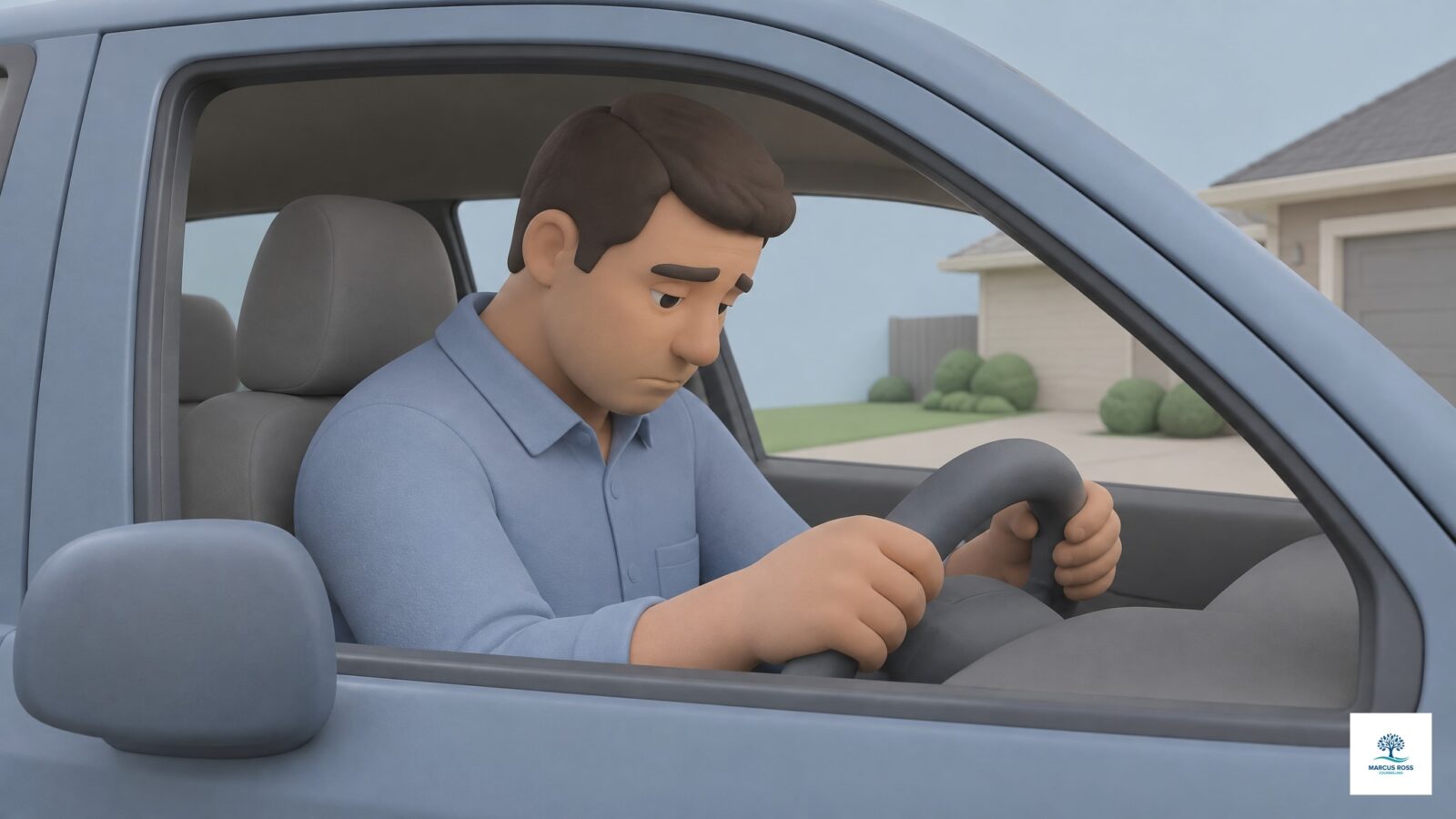
In my counselling practice, I consistently see men in their 30s to 50s describe feelings of failure not as sadness, but as a deep sense of being fundamentally flawed when their life path diverges from what they expected. You might be sitting in your car after work, staring at the steering wheel, wondering how you became a stranger in your own life, even though you ticked every box society handed you. This isn’t just about losing a partner or a job title. It’s about losing the evidence that you are who you said you were.
Men are often socialised to equate their value with provision, protection, and performance. That makes identity disruption feel like a moral failing rather than a circumstantial challenge. When the marriage ends or the redundancy letter arrives, the loss strips away the external scaffolding you used to prove your worth to yourself and everyone else.
A common presentation involves men who have navigated divorce or job loss describing themselves as “useless” or “broken,” even when they continue to function adequately in daily responsibilities. You still pay the bills, turn up for the kids, and keep the house standing, but internally you feel like a fraud wearing a costume of competence. This is where identity loss after separation or career change becomes so corrosive. Without those traditional markers, you struggle to locate any solid ground beneath your feet. The shame doesn’t announce itself clearly. Instead, it hides behind behaviours that look nothing like vulnerability on the surface.
Having navigated my own relationship breakdown and identity loss, I understand firsthand how disorienting it feels when the blueprint you followed no longer applies.
Shame in men frequently masquerades as irritability, emotional withdrawal, or an obsessive drive to overwork, because these behaviours feel safer than admitting defeat. You might find yourself snapping at loved ones over minor issues or retreating into long hours at work, not because you don’t care, but because stopping forces you to confront the void underneath. Anger feels powerful. Shame feels annihilating, and that’s exactly why it’s so hard to name, let alone address. When you experience pain that turns to anger instead of words, you protect yourself from the raw exposure of inadequacy, but you also cut off the very connection that could help you heal. Your mates might tell you to toughen up or distract yourself, reinforcing the idea that this internal collapse is something to be managed privately rather than understood.
This hurts more than standard grief because our culture hasn’t given men permission to grieve the loss of an imagined future without judging their masculinity. Sadness says “I lost something valuable.” Shame whispers “I am not valuable enough to have kept it.” That distinction matters, because you cannot process shame with the same tools you use for sorrow. It requires witnessing and validation rather than just time or distraction.
You aren’t failing at being a man because your circumstances changed. You’re experiencing a predictable human response to having your foundational narratives shattered, and recognising that pattern is the first step toward untangling it. You cannot fix what you refuse to name.
Reframing Identity Beyond Traditional Milestones
Rebuilding after the old script breaks isn’t about clawing your way back to who you were before everything fell apart. That version of you was built on foundations that proved fragile under pressure, so returning there would only recreate the same vulnerability. True reconstruction happens when you stop measuring your worth by assets, titles, or relationship status and start anchoring it in values that no external event can confiscate. This shift feels terrifying at first, because it demands you trust something invisible over the tangible proof points you’ve relied on for decades.
You have to integrate the loss into a new sense of self rather than treating it as a temporary detour back to normalcy. This means accepting that the man who emerges from this period will be different from the one who entered it, and that difference isn’t a deficit. Resilience isn’t bouncing back to your previous shape. It’s expanding your capacity to hold complexity without collapsing. When you separate your identity from outcomes, you gain a stability that redundancy notices and separation papers can’t touch. This internal work is slow and often uncomfortable, but it builds a foundation that belongs entirely to you.
Counselling doesn’t restore your old life or guarantee you’ll never feel this kind of disorientation again. No therapeutic approach can shield you from the inherent uncertainty of being human. What it offers instead is a structured space to examine which parts of your old identity served you and which were merely inherited expectations you mistook for truth. You learn to distinguish between genuine personal failure and the inevitable friction of living in a world that changes without your permission.
Finding Support That Actually Fits
Asking for help when you’ve spent your whole life being the reliable one triggers a deeply ingrained resistance that has nothing to do with logic. You know, intellectually, that talking to someone makes sense. But your nervous system interprets reaching out as confirmation that you’ve finally cracked.
This self-reliance conditioning that makes reaching out hard is exactly why so many men suffer in silence until the pressure becomes unbearable. Acknowledging this barrier doesn’t mean you’re weak. It means you’re paying attention to the real obstacle standing between you and relief.
Taking the First Step Without Pressure
Counselling isn’t about lying on a couch dissecting your childhood or being told what you should have done differently. It’s a practical, collaborative space where you untangle the shame from the circumstances and figure out what comes next on your own terms. If you’re curious about what actually happens in a counselling session, knowing the mechanics beforehand can lower the threshold enough to make that first contact feel manageable. You deserve clarity about the process before you commit to anything, because trust is built on transparency, not blind faith.
A free 20-minute Connect Call gives you the chance to test whether this feels like the right fit, with no obligation to continue. We talk briefly about what’s bringing you in, I answer whatever questions you have, and you get to gauge whether my approach resonates with how you operate. There’s no assessment, no diagnosis, and no pressure to book a follow-up if it doesn’t land right. Sometimes just hearing another bloke articulate what you’ve been carrying is enough to shift the weight slightly. That shift is where real change begins.
Common Questions About Shame and Seeking Support
How do I know if what I’m feeling is shame or just depression?
Depression often presents as persistent low mood, fatigue, and loss of interest across all areas of life, while shame specifically targets your sense of self-worth tied to perceived failures or unmet expectations. Shame makes you want to hide or disappear because you feel fundamentally defective, whereas depression can exist without that specific self-judgment. Both can coexist, but shame responds best to being witnessed and validated rather than solely through medication or behavioural activation.
Will counselling force me to talk about things I’m not ready to share?
No, you set the pace and boundaries for what gets discussed in every session. A trauma-informed counsellor respects your readiness and works with what you bring, never forcing disclosure before you feel safe enough to offer it. The goal is building enough trust over time that sharing becomes a choice rather than an extraction.
Is it too late to rebuild my identity after years of feeling stuck?
Identity reconstruction isn’t bound by age or duration of struggle; men in their 40s, 50s, and beyond regularly discover new ways of defining themselves after major transitions. The work takes longer when patterns are deeply entrenched, but the capacity for growth doesn’t expire. What matters more than timing is willingness to examine what no longer serves you.
What if I try counselling and it doesn’t help?
Not every therapeutic relationship fits, and finding the right match sometimes takes more than one attempt. The free Connect Call exists precisely to reduce the risk of investing time and money in something that doesn’t align with how you process. If it doesn’t work, that’s useful information about what you need rather than proof that support itself is futile.