
Why Men Lose Identity After Separation & Career Change
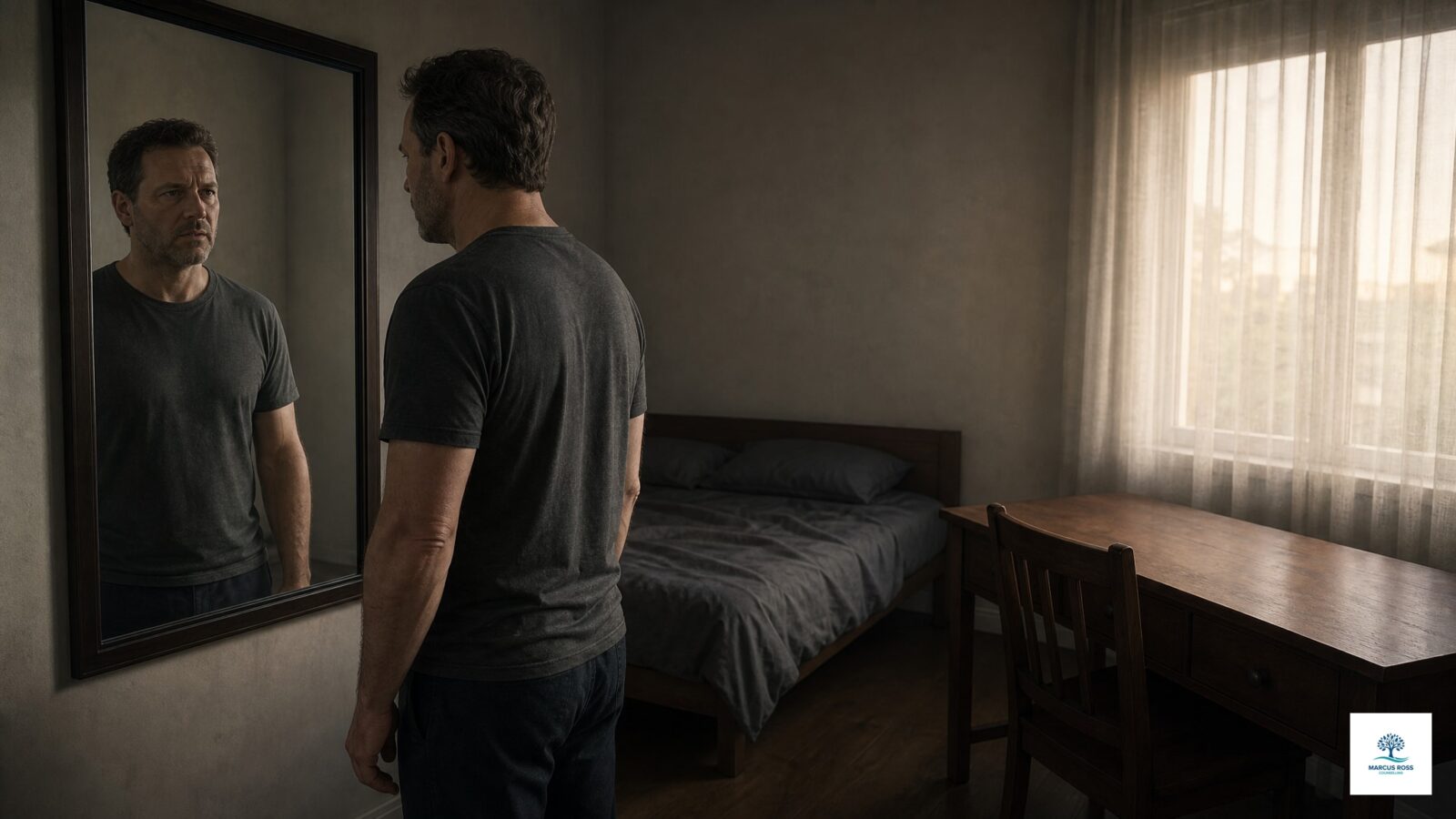
You wake up one morning and the silence in the house feels heavier than usual. Or you’re at your desk, realising the job title that defined you for twenty years doesn’t carry any weight anymore. It’s disorienting to look in the mirror and not quite recognise the bloke staring back, because the external markers of who you were have been stripped away.
This erosion of self isn’t a personal failure or a sign of weakness. It’s a predictable response to losing the roles that once anchored your existence.
I know this terrain well. I walked through it myself after my own relationship breakdown and the rebuilding that followed. My counselling practice exists to give you a space to untangle these feelings without judgement or clinical jargon, whether you’re navigating separation, a career pivot, or a general sense of disconnection. Understanding why men lose their identity after separation, career changes, or drifting from things they once enjoyed is often the first step toward finding solid ground again.
Recognising Identity Loss in Men
Identity loss happens when the roles you built your life around suddenly vanish or change beyond recognition. You might have spent decades as a husband, a father living in the family home, a provider, or a tradie with a specific reputation. Now those defining structures are gone, or fundamentally altered. This isn’t just sadness about an event. It’s a deep confusion about who you actually are once the titles are removed.
Many blokes describe this as feeling like a ghost in their own life, drifting through days without a clear sense of direction. You might still go to work or see friends, yet underneath there’s a persistent hollowness, because the internal narrative that used to make sense has collapsed. This experience is valid, and far more common than most men admit, even if few talk about it openly over a beer.
It helps to distinguish this from clinical depression, though the two can certainly overlap and need different approaches. Grief over a lost identity is a normal response to massive change. Depression, on the other hand, often involves a low mood that persists regardless of circumstances. If you’re unsure where you sit, knowing when to reach out can help you tell the difference between transitional grief and something that needs more intensive support.
This process doesn’t fix itself just by staying busy or throwing yourself into new projects. Avoiding the discomfort only prolongs the disorientation. The work of rebuilding means facing the void rather than running from it.
How Separation Disrupts a Man’s Sense of Self
Divorce and separation don’t just end a relationship. They dismantle the daily architecture that gave your life shape and meaning. The routines you shared, the future plans you made, even the way you introduced yourself at social gatherings, were all tied to being part of a couple. When that partnership dissolves, you lose not only a person but the mirror they held up to you every day.
For many men, their partner was also their primary emotional confidant, the person who managed the social calendar, the domestic rhythms, the connection to extended family. Losing that relational anchor leaves you untethered in ways that dividing assets or organising childcare never quite captures. You might find yourself struggling to answer simple questions, like what you want for dinner or how to spend a Sunday afternoon, because those decisions were always negotiated within a partnership.
This grief is distinct from the legal and financial stress of separation, even though they happen at the same time. Lawyers handle the paperwork and mediators sort out care arrangements, but nobody hands you a roadmap for reconstructing a solo identity after years of operating as a unit. The pain of this loss is real and deserves its own acknowledgement, separate from the practical chaos around it.
You deserve a space where this specific type of loss is understood, not minimised or rushed. Rebuilding identity after divorce is rarely a straight line, and having someone who has walked this exact terrain can be the difference between floundering and finding your footing.
The shame that often comes with this disruption is usually unspoken but deeply felt. Society expects men to be resilient and self-sufficient, so admitting you feel lost without your partner can feel like admitting defeat. Yet this vulnerability is actually where genuine growth starts, because it forces you to build an identity rooted in your own values rather than borrowed roles.
If you’re in the early stages of this, regaining confidence after separation often begins with small, manageable steps rather than grand gestures. Confidence comes back when you start trusting your own judgment again in everyday decisions, not when you hit some external milestone of recovery.
Career Transitions and the Loss of Professional Identity
Your profession often gives you more than income. It supplies structure, status, community, and a ready-made answer to who you are. When you lose a job, retire, or pivot careers, you lose access to that whole ecosystem of validation and belonging. The business cards stop working, the work mates drift away, and the sense of competence that came from mastering a role evaporates overnight.
Men are frequently raised to equate their worth with productivity and earning capacity, which makes career transitions uniquely threatening to a man’s sense of self. Even if you chose to leave a toxic workplace or retire at the age you’d planned, the absence of professional structure can trigger unexpected shame and anxiety. You might feel useless on a weekday morning when you used to be essential, or struggle to introduce yourself at a party without the shorthand of a job title.
This transition often exposes how much of your self-concept was outsourced to an employer or an industry. Without the feedback loop of performance reviews, client praise, or team camaraderie, you’re left to generate your own sense of value from scratch. That internal work is uncomfortable and unfamiliar if you’ve spent decades drawing purpose from external achievement.
Voluntary career changes carry their own particular weight of uncertainty, even when you chose them freely. You might have left a stable job to pursue meaningful work, or better health, and still grieve the loss of certainty that came with the old role. Acknowledging that ambivalence doesn’t mean you made the wrong choice. It means you’re human.
Your worth as a man exists independently of your employment status or how productive you feel. Separating your identity from your output is difficult cultural work, but it builds resilience against future disruptions and opens space for a more sustainable sense of purpose.
When Hobbies and Passions Stop Feeling Meaningful
Activities that once brought you joy can suddenly feel hollow after major life upheaval. Fishing, sport, woodworking, music, whatever it was, might have been a reliable source of satisfaction, and now it feels like going through the motions. This disconnection isn’t laziness or ingratitude. It signals that the context supporting those passions has shifted.
Hobbies often get their meaning from the relationships and identities around them rather than existing on their own. Playing weekend footy mattered because of the team bonds and shared purpose. Restoring cars was fulfilling because it connected you to your father, or to a community of blokes who cared about the same thing. When those relational anchors disappear through separation, relocation, or a changing life stage, the activity itself loses its emotional pull.
Depression can also flatten pleasure in things you used to enjoy, so it’s worth noticing whether this disconnection is situational or spread across everything. If nothing satisfies you and low mood persists across every part of life, it’s worth getting a professional assessment. But if specific hobbies feel empty while other moments of connection remain possible, you’re more likely experiencing an identity recalibration than clinical depression.
Forcing yourself to keep doing activities that no longer fit can deepen the alienation rather than fix it. Sometimes the honest response is to admit a passion served its purpose in a previous chapter of your life and now needs to be let go. Making space for new interests means tolerating the beginner’s discomfort of not being good at something yet.
Exploring what genuinely engages you now, rather than clinging to what used to work, is an act of self-respect. It takes time and patience, because you can’t manufacture real interest through willpower alone.
Navigating the Space Between Old and New
The period between losing an old identity and forming a new one is uncomfortable, and it resists quick fixes. You can’t think your way into a new sense of self. You have to live your way there, through experimentation, reflection, and gradual adjustment. This in-between space feels like wandering, but it’s actually the groundwork for change that lasts.
Many men try to skip this discomfort by jumping straight into new roles or distractions that replicate the structure they lost. A rebound relationship, overworking, obsessively chasing fitness, these can all provide temporary relief from the void. But they delay the underlying identity work rather than resolve it, because they dodge the real question of who you are when nobody’s watching.
Genuine reconstruction happens in smaller moments of honesty and curiosity. It looks like noticing what actually energises you versus what you think should. It means tolerating the awkwardness of trying new things with no guarantee of success or anyone patting you on the back for it.
What Support Actually Looks Like
Reaching out for help can feel daunting if your only reference points are clinical stereotypes or a fear of being told what’s wrong with you. Many men hesitate because they picture therapy as lying on a couch dissecting childhood trauma. The reality of modern counselling for men is far more practical, collaborative, and grounded in lived experience.
Sessions are typically a straightforward conversation about what’s happening in your life right now and what you want to change. We look at patterns, identify strengths you might be overlooking, and work out concrete strategies for the transition you’re in. There’s no pressure to perform emotions or use therapeutic language that feels foreign to you.
If you’re curious but unsure, what therapy actually looks like walks through the process without overselling the outcome. Understanding the actual mechanics of a session removes a lot of the anxiety about taking that first step.
Counselling isn’t a magic fix that instantly restores purpose or erases grief. It’s a structured space for doing the work you’d otherwise attempt alone, with someone who understands the specific challenges men face during identity transitions. The pace stays yours, and there’s no timeline you need to hit.
Taking the Next Step at Your Own Pace
Recognising yourself in these descriptions doesn’t mean you have to commit to ongoing therapy right away. Sometimes just reading about these experiences is enough to shift something. Other times, talking it through with someone who gets it can tell you whether professional support would help right now.
A free 20-minute Connect Call is a low-pressure way to work out whether working together makes sense for you. There’s no sales pitch and no expectation you’ll book further sessions. It’s simply a chance to ask questions, share what you’re going through, and get a feel for how we might work together. You stay completely in control of what happens next.
Whether you reach out now or later, know this: questioning your identity after a major life change is a sign of awareness, not brokenness. The fact that you’re seeking to understand it means you’re already doing the work of rebuilding, even when it doesn’t feel like progress yet. Support options for men are there when you’re ready, and there’s no wrong time to start exploring what comes next.